
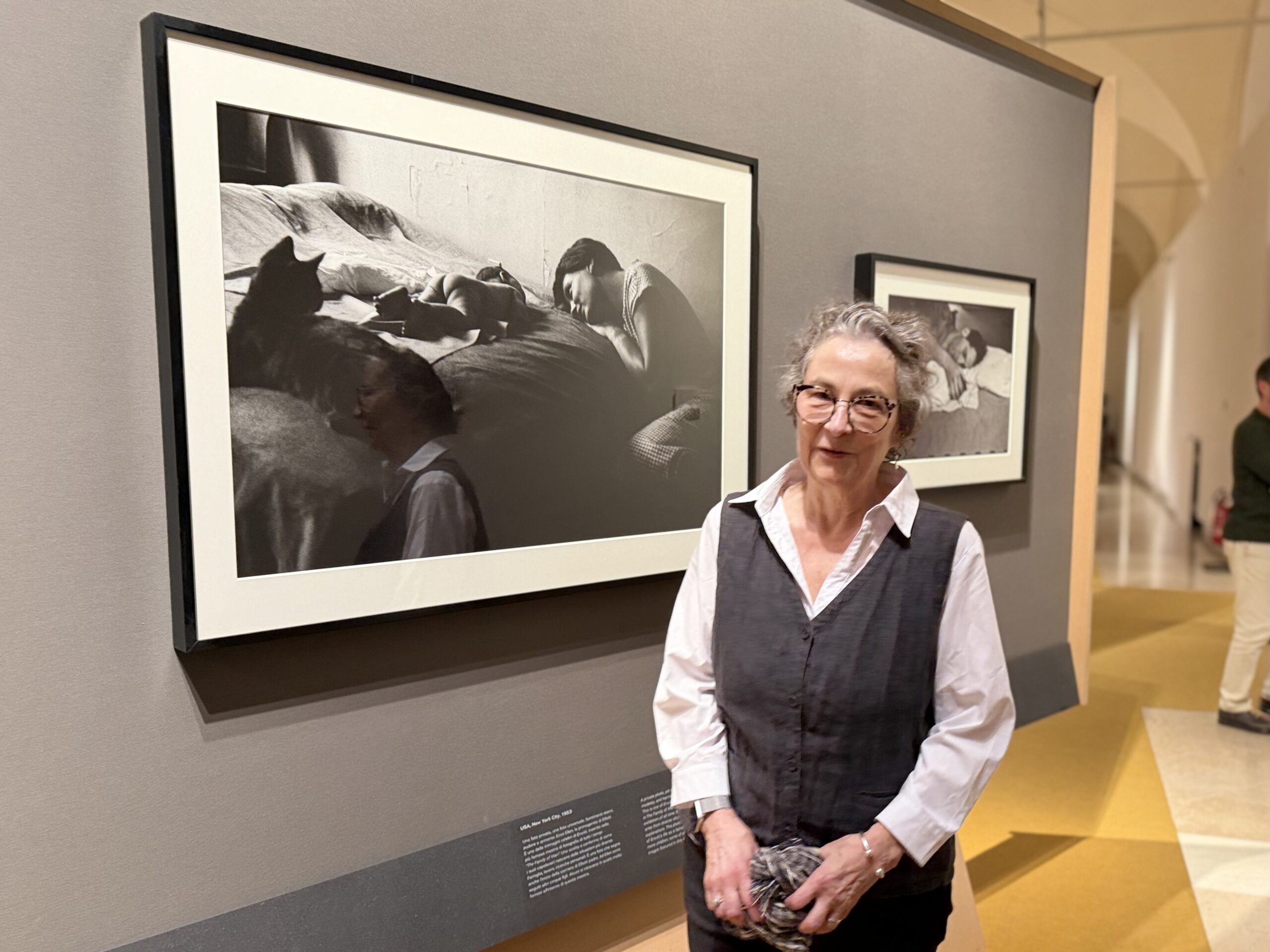
Ellen Erwitt a Bologna si riflette in “Mum & Child “di Eliott Erwitt – foto di Beatrice Di Pisa
( English version ⤵️)
Elliott Erwitt, la fotografia e la memoria: l’incontro con sua figlia Ellen a Bologna
Quando questa mattina ci è stato proposto di intervistare Ellen Erwitt, figlia di uno dei più grandi fotografi del Novecento, abbiamo accolto con entusiasmo l’opportunità.
Incontrare Ellen significava avvicinarci non soltanto alla straordinaria opera di Elliott Erwitt, ma anche alla dimensione più intima della sua vita, attraverso i ricordi e lo sguardo di chi lo ha conosciuto prima di tutto come padre.
E l’incontro di oggi è stato proprio questo: una conversazione piacevole, intensa, ricca di racconti e aneddoti che ci hanno restituito un ritratto autentico e profondamente umano di un artista straordinario.
Ellen ha una delicatezza particolare nel raccontare che emerge soprattutto quando parla delle immagini più intime, quelle che per noi rappresentano capolavori della storia della fotografia e che per lei sono, prima di tutto, frammenti della propria infanzia e della propria famiglia.
È lei, per esempio, la bambina ritratta nel celebre scatto Mother and Child, insieme alla madre e al gatto di famiglia. Un’immagine diventata iconica, esposta nel 1955 al MoMA di New York in occasione della storica mostra The Family of Man, curata dal grande fotografo Edward Steichen.
E proprio Steichen compare in un’altra fotografia presente nell’esposizione bolognese, mentre tiene in braccio la piccola Ellen. Un’immagine che crea un suggestivo legame tra la storia della fotografia e i ricordi personali di una bambina che, oggi, custodisce e valorizza l’eredità artistica del padre.
Nella mostra in corso al Museo Civico Archeologico di Bologna ritroviamo anche altri frammenti di quella storia familiare: i volti delle persone amate, i ricordi dell’infanzia, le fotografie della nonna. Immagini che appartengono alla memoria privata di Ellen, ma che sono diventate parte della storia della fotografia.
Ed è proprio questo uno degli aspetti più affascinanti dell’incontro: ascoltare una donna che è cresciuta dentro le fotografie del padre, che ne è stata protagonista e che oggi contribuisce a custodirne e valorizzarne l’immenso patrimonio artistico.
Attraverso il lavoro della fondazione dedicata a Elliott Erwitt e la realizzazione di mostre, Ellen continua a mantenerne viva la memoria, offrendo a tutti noi l’opportunità di conoscere e approfondire uno sguardo sul mondo che non ha mai smesso di sorprenderci.
La splendida esposizione bolognese, che vi consigliamo vivamente di visitare, è curata da Biba Giacchetti, che ha lavorato al fianco di Elliott Erwitt per trent’anni, conoscendone profondamente non soltanto l’opera, ma anche la personalità.
Particolarmente interessante è il catalogo che accompagna la mostra “Elliott Erwitt. Icons”, nel quale alcune delle immagini più iconiche del fotografo, provenienti dalla sua collezione privata, sono accompagnate dai testi di Erwitt e di Biba.
Ne nasce una sorta di dialogo che svela il dietro le quinte delle fotografie: gli scatti costruiti con attenzione per ottenere un risultato preciso, quelli commissionati, quelli nati dalla spontaneità di un istante. E sempre quella straordinaria ironia che ha reso inconfondibile lo sguardo del fotografo americano.
Perché Elliott Erwitt aveva un talento raro: riusciva a cogliere l’assurdità, la tenerezza, le contraddizioni e la bellezza della vita quotidiana, trasformandole in immagini capaci di parlare a chiunque, senza bisogno di spiegazioni.
Ascoltare Ellen significa anche comprendere quanto sia sottile il confine tra memoria personale e storia della fotografia. E quanto sia prezioso il lavoro di chi continua a custodire, studiare e condividere l’eredità artistica di un padre, trasformando i ricordi di famiglia in un patrimonio culturale accessibile a tutti.

Durante l’incontro non è mancato un riferimento alla politica americana. Rispondendo alla domanda di una delle giornaliste presenti, Ellen ha ricordato le elezioni presidenziali del 2016 e la delusione vissuta in famiglia: «Quando ci siamo resi conto che, al posto di Hillary Clinton, aveva vinto un altro».
Una frase pronunciata senza fare nomi, ma che racconta molto.
Un ricordo che, inevitabilmente, riporta al presente e alle contraddizioni di un Paese che Elliott Erwitt ha raccontato per decenni con uno sguardo libero, ironico e profondamente umano.
E allora mi piace concludere questo racconto con una fotografia che ho scattato durante l’incontro: Ellen davanti a un ritratto di famiglia realizzato a East Hampton nel 2009, mentre indica alcuni dei suoi protagonisti.
Alle loro spalle, una riproduzione della Statua della Libertà.
Un’immagine che racchiude la dimensione familiare, l’ironia e quello sguardo sull’America che hanno attraversato l’opera di Elliott Erwitt.
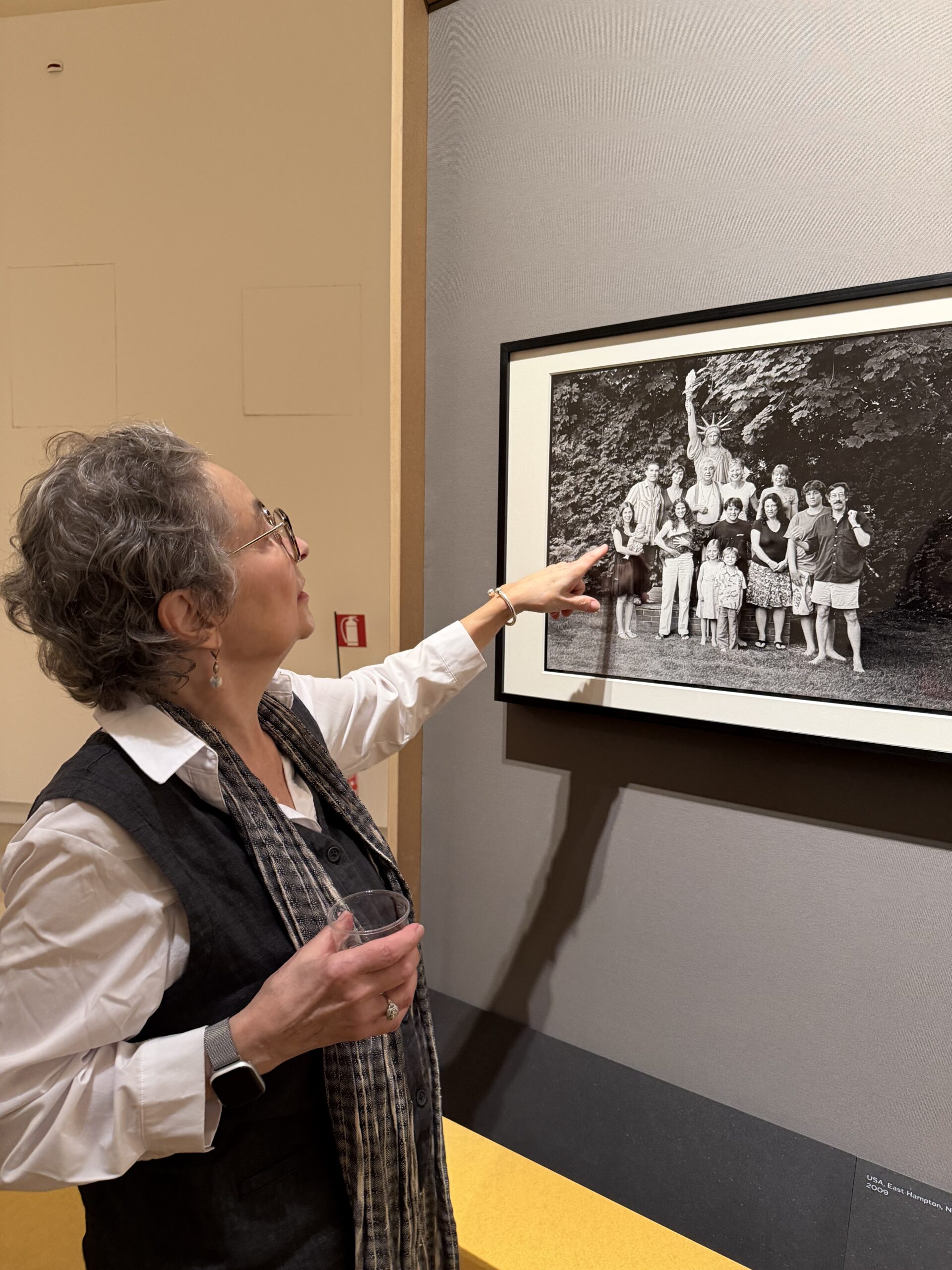
E oggi, dopo le parole di Ellen, quella Statua della Libertà sembra assumere un significato ulteriore. Un simbolo che invita a riflettere sulla libertà, sui valori che rappresenta e sulle contraddizioni dell’America contemporanea.
Ma ciò che più mi colpisce è il gesto di Ellen, che indica i volti della propria famiglia. Perché in quel momento non è soltanto la custode dell’eredità di uno dei più grandi fotografi del Novecento. È una figlia che ritrova, dentro una fotografia, la propria storia.
Perché Elliott Erwitt ci ha insegnato che una fotografia può raccontare molto più di ciò che mostra. Può custodire la memoria, attraversare la storia, farci sorridere e, nello stesso tempo, interrogarci sul presente.
Sono uscita da questo incontro con la sensazione di aver conosciuto Elliott Erwitt un po’ di più. Non soltanto attraverso il suo obiettivo, ma attraverso gli occhi di sua figlia.
A questa bellissima mostra abbiamo dedicato uno spazio speciale nello corso numero di Bologna.
Sfoglialo qui Bologna da Vivere
Nel frattempo, il mio invito è semplice: andate a vederla.
Perché ci sono fotografie che non smettono mai di parlarci. E quelle di Elliott Erwitt sono certamente tra queste.
Beatrice Eugenia Di Pisa
ELLIOTT ERWITT. L’ARTE DI OSSERVARE
Museo Civico Archeologico di Bologna
Sede: Via dell’Archiginnasio 2, Bologna
Periodo: dal 1° ottobre 2026 al 28 febbraio 2027
A cura di: Biba Giacchetti
Orari di apertura
- Lunedì, mercoledì, giovedì e venerdì: 10.00–18.00
- Sabato, domenica e festivi: 10.00–19.00
- Martedì: chiuso
- La biglietteria chiude un’ora prima della chiusura della mostra.
English version
Elliott Erwitt, Photography and Memory: Meeting His Daughter Ellen in Bologna
When we were offered the opportunity to interview Ellen Erwitt, daughter of one of the greatest photographers of the twentieth century, earlier this morning, we accepted with enthusiasm.
Meeting Ellen meant discovering not only the extraordinary work of Elliott Erwitt, but also the more intimate side of his life, through the memories and perspective of someone who knew him, first and foremost, as a father.
And that is precisely what today’s meeting turned out to be: a warm, engaging conversation, filled with stories and anecdotes that offered us an authentic and deeply human portrait of an extraordinary artist.
There is a particular gentleness in the way Ellen tells her stories, especially when she speaks about the most intimate photographs — images that we regard as masterpieces in the history of photography, but which, for her, are above all fragments of her childhood and family life.
She is, for example, the little girl portrayed in the celebrated photograph Mother and Child, alongside her mother and the family cat. An image that became iconic and was exhibited at New York’s Museum of Modern Art (MoMA) in 1955 as part of the historic exhibition The Family of Man, curated by the renowned photographer Edward Steichen.
Steichen himself appears in another photograph featured in the Bologna exhibition, holding little Ellen in his arms. It is an image that creates a fascinating connection between the history of photography and the personal memories of a child who, today, preserves and promotes her father’s artistic legacy.
The exhibition currently on display at Bologna’s Civic Archaeological Museum also reveals other fragments of that family history: the faces of loved ones, childhood memories, photographs of her grandmother. Images that belong to Ellen’s private memories but have also become part of the history of photography.
And this is precisely one of the most fascinating aspects of our encounter: listening to a woman who grew up surrounded by her father’s photographs, who became a subject of his work herself, and who now helps preserve and celebrate his immense artistic heritage.
Through her work with the foundation dedicated to Elliott Erwitt and her involvement in organising exhibitions, Ellen continues to keep his memory alive, offering all of us the opportunity to discover and explore a way of looking at the world that never ceases to surprise us.
The wonderful exhibition in Bologna, which we wholeheartedly recommend visiting, is curated by Biba Giacchetti, who worked alongside Elliott Erwitt for thirty years and came to know not only his work but also his personality intimately.
Particularly interesting is the exhibition’s accompanying catalogue, Elliott Erwitt. Icons, which brings together some of the photographer’s most iconic images from his private collection, accompanied by texts written by Erwitt and Biba Giacchetti.
The result is a kind of dialogue that reveals the stories behind the photographs: carefully staged shots designed to achieve a particular result, commissioned works, and images born from the spontaneity of a fleeting moment. And always, that extraordinary sense of humour that made the American photographer’s vision so unmistakable.
For Elliott Erwitt possessed a rare talent: he could capture the absurdity, tenderness, contradictions and beauty of everyday life, transforming them into images capable of speaking to anyone, without the need for explanation.
Listening to Ellen also means understanding how delicate the boundary between personal memory and the history of photography can be. And how valuable the work of those who continue to preserve, study and share a father’s artistic legacy truly is, transforming family memories into a cultural heritage accessible to everyone.
During the meeting, the conversation also turned to American politics. In response to a question from one of the female journalists present about the political situation in the United States and the midterm elections, Ellen recalled the disappointment her family experienced during the 2016 presidential election: “When we realised that, instead of Hillary Clinton, someone else had won.”
A remark made without mentioning any names, yet one that speaks volumes.
A memory that inevitably brings us back to the present and to the contradictions of a country that Elliott Erwitt portrayed for decades with a free, ironic and deeply human perspective.
And so I would like to conclude this story with a photograph I took during the meeting: Ellen standing in front of a family portrait taken in East Hampton in 2009, pointing out some of the people in the picture.
Behind them stands a replica of the Statue of Liberty.
An image that brings together the family dimension, the irony and that distinctive perspective on America that runs throughout Elliott Erwitt’s work.
And today, after hearing Ellen’s words, that Statue of Liberty seems to take on an additional meaning. A symbol that invites us to reflect on freedom, the values it represents and the contradictions of contemporary America.
But what strikes me most is Ellen’s gesture as she points to the faces of her family. Because, in that moment, she is not simply the guardian of the legacy of one of the greatest photographers of the twentieth century. She is a daughter rediscovering her own story within a photograph.
Elliott Erwitt taught us that a photograph can tell us far more than what it shows. It can preserve memories, transcend time, make us smile and, at the same time, encourage us to question the present.
I left the meeting feeling that I had come to know Elliott Erwitt a little better. Not only through his lens, but through his daughter’s eyes.
We have dedicated a special feature to this wonderful exhibition in the latest issue of Bologna.
In the meantime, my invitation is simple: go and see it.
Because some photographs never stop speaking to us. And Elliott Erwitt’s are certainly among them.
Beatrice Eugenia Di Pisa
ELLIOTT ERWITT. THE ART OF OBSERVATION
Museo Civico Archeologico di Bologna
Bologna Civic Archaeological Museum
Venue: Via dell’Archiginnasio 2, Bologna, Italy
Exhibition dates: October 1, 2026 – February 28, 2027
Curated by: Biba Giacchetti
Opening Hours
Monday, Wednesday, Thursday and Friday: 10:00 am – 6:00 pm
Saturday, Sunday and public holidays: 10:00 am – 7:00 pm
Tuesday: Closed
The ticket office closes one hour before the exhibition closes.